I. The Real-World Coordinates of the Wi-Fi 8 Standard Progress
Just two days ago, Qualcomm's Dragonwing platform released a signal at Network X 2026 – the Wi-Fi 8 gateway solution was launched. To understand this, we need to clarify the current standard stage of Wi-Fi 8.
At the IEEE plenary meeting in Montreal in July 2026, the 802.11bn task force voted to submit Draft 2.0 to the working group for a vote, thus finalizing the core features of Wi-Fi 8. According to the timeline disclosed by ABI Research, Draft 3.0 voting is scheduled for January 2027, Draft 4.0/initial standards association voting is targeted for May 2027, final working group approval is set for March 2028, IEEE standards committee approval is expected for May 2028, and the Wi-Fi Alliance certification program is expected to launch in January 2028.
The key implication of this timeline is that Wi-Fi 8 will still be in the draft standard stage in 2026, with certified products and large-scale commercialization not truly starting until 2028. However, chip platform and module solution providers have already significantly accelerated their product development pace. Broadcom was the first to release Wi-Fi 8 chipsets in October 2025, followed by MediaTek and Qualcomm. By September 2026, the Wi-Fi Alliance had already held its first Wi-Fi 8 pre-certification interoperability Plugfest in Beijing, Taipei, and California. While the standard has not yet been finalized, the industry's engineering preparations are already in full swing.
II. The Differentiated Deployment Logic of Qualcomm's Dragonwing Platform
Qualcomm's Dragonwing product portfolio, showcased at Network X 2026, presents a clear market segmentation strategy.
designed for mainstream fiber broadband gateways . According to Qualcomm's official product briefing, the F8 integrates Wi-Fi 8 connectivity and native PON architecture support, targeting Home Gateway Units (HGUs) and Single Units (SFUs). Key specifications include: peak wireless capacity of 23Gbps, support for up to 750 concurrent clients, up to three-band operation and a 14-antenna configuration , flexible RF configuration allowing for a 5x5 mode or splitting into dual-band simultaneous 2x2+3x3 modes, and native support for GPON, XG-PON, and XGS-PON standards. The platform supports open-source middleware such as prplOS, OpenWRT, RDK, and OpenSync, and is equipped with a dedicated scanning radio frequency for automatic channel selection and radar detection.
designed for high-end enterprise access points (APs) and flagship home routers . Its specifications are significantly improved: peak wireless capacity of 33Gbps, support for up to 1500 concurrent clients, up to five frequency bands and a 20-antenna configuration , integrated five-core CPU and Hexagon NPU, and support for edge AI inference. Developed in collaboration with GFiber, this platform, a Wi-Fi 8 Premium Gateway, aims to support symmetric 20Gig broadband services, redefining the gateway from a "connected device" to a "smart service platform."
Meig Smart chose to launch its Wi-Fi 8 gateway solution on the N8 platform, officially announcing it at Network X 2026 on October 14th. The industry significance of this launch lies in the fact that the entire engineering transformation chain of a Wi-Fi 8 gateway, from chip platform to deliverable solution, has been fully demonstrated for the first time. For downstream customers, the Wi-Fi 8 gateway is no longer a distant concept "waiting for the standard to be finalized," but rather an evaluable chip base and a referenceable solution design.
III. Generational Positioning of Qogrisys Gateway Module Product Line
Although manufacturers are currently rushing to implement their strategies in advance, WiFi 7 and WiFi 6 remain the mainstays of shipments. They are more mature than WiFi 8 and are still the preferred choice. During this window of opportunity before the Wi-Fi 8 standard is finalized, gateway module solution providers need to strike a balance between technological foresight and market deliverability in their product strategies. Qogrisys's two main gateway module products are precisely designed to meet different levels of demand during this transition period.
Wi-Fi 7 Platform: O2072PM and O2072PB
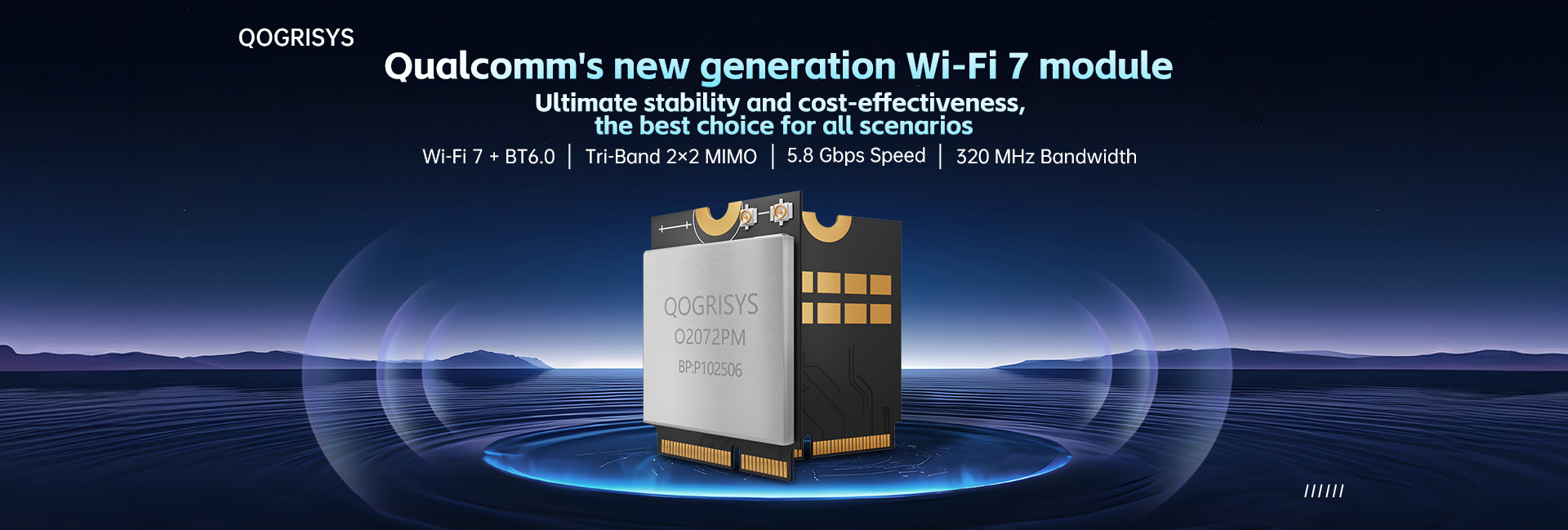
The O2072PM is based on the Qualcomm FastConnect C7700 (QCC2072) chip, uses a standard M.2 Key E interface (22×30mm), and supports Wi-Fi 7 (802.11be) and Bluetooth 6.0. Its core capabilities include: tri-band 2.4/5/6GHz concurrent operation; the 6GHz band supports 320MHz channel bandwidth and 4096QAM modulation, with a peak rate of 5.8Gbps ; and it supports 320MHz Enhanced Multi-Link Single Radio (eMLSR) , enabling millisecond-level switching when the link is interfered with. This module has completed driver adaptation for Intel x86 platforms with kernels 5.15.24+, 6.1.99, and 6.12.0.
The O2072PB is based on the same QCC2072 chip and uses a 15×13mm surface mount package, targeting space-constrained onboard integration scenarios.
Wi-Fi 6E Platform: O2066PM and O2066PB
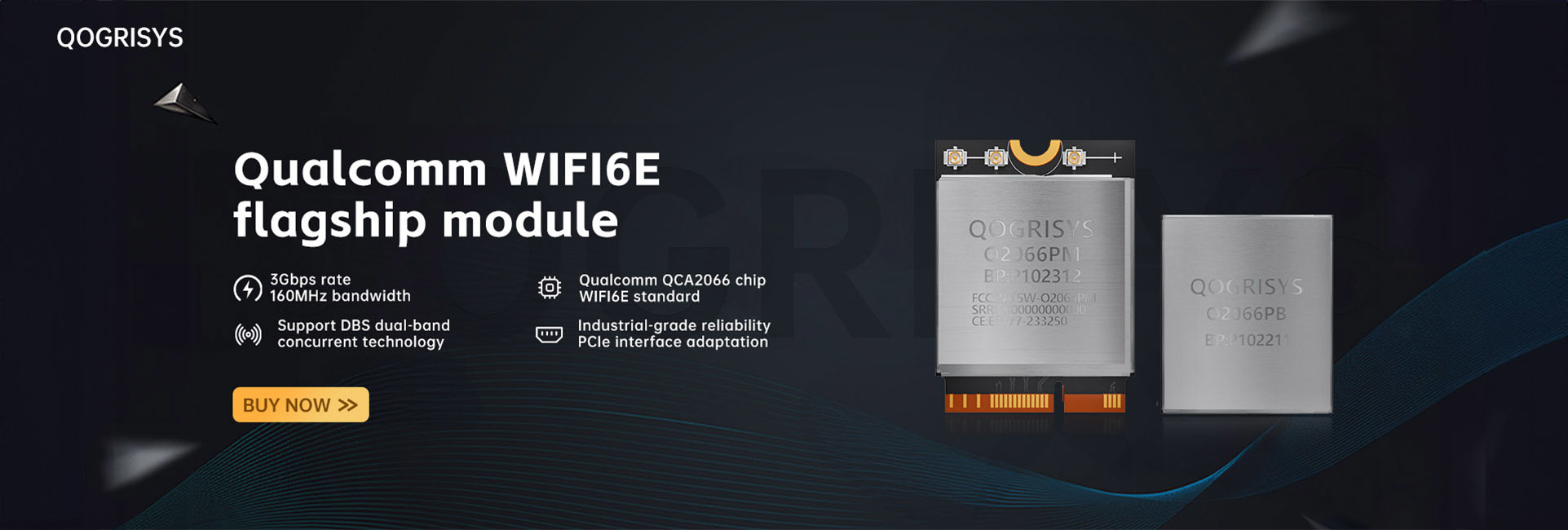
The O2066PM is based on the Qualcomm QCA2066 chip and uses a standard M.2 2230 Key E interface (22×30×2.7mm), supporting Wi-Fi 6E (802.11ax) and Bluetooth 5.2. Key specifications include: tri-band 2.4/5/6GHz support, dual-band simultaneous (DBS) operation, and a maximum speed of 2975.6Mbps ; support for 2×2 MU-MIMO, 160MHz channel bandwidth, and dynamic frequency selection (DFS radar detection). The Bluetooth interface supports both UART/PCM and USB configurations. The module operates in a temperature range of -30℃ to +85℃ , exhibiting industrial-grade stability. In VR products, it has achieved a measured throughput of 2.1Gbit/s and has been designed into customer VR products, which were showcased at CES 2023.
The O2066PB is based on the same QCA2066 chip, and its core capabilities are identical to the O2066PM; the difference lies in its package form. It uses a small SMT LGA package, measuring 13×15×2.3mm , targeting space-constrained onboard integration scenarios. Wi-Fi uses a PCIe interface, and Bluetooth uses a UART/PCM interface. Its operating temperature range is -30℃ to +70℃ , making it suitable for consumer-grade terminal devices.
the O2072 series is logically consistent with the "high reliability connection" emphasized by Wi-Fi 8—Wi-Fi 7's MLO provides an engineering implementation of link redundancy, while Wi-Fi 8's Multi-AP Coordination (MAPC) extends the coordination scope from a single device to a multi-node network. The O2066 series represents another path: during the transition period when the cost of Wi-Fi 7 modules has not yet dropped to an acceptable level for low-end and mid-range gateways, Wi-Fi 6E's 6GHz band capability provides cost-sensitive customers with a "partial generational upgrade" option .
IV. Generational Transition Logic Between Chip Platforms and Module Products
From Wi-Fi 6E to Wi-Fi 7 and then to Wi-Fi 8, the technological evolution path of gateway modules shows a clear continuity.
The core improvement of Wi-Fi 8 over Wi-Fi 7 lies not in peak speed . According to industry technical analysis, Wi-Fi 8 is compatible with Wi-Fi 7's 2.4/5/6GHz tri-band, 320MHz channel, and 4096QAM. Existing Wi-Fi 7 RF architectures can support these core features through firmware upgrades . Wi-Fi 8 offers approximately double the actual throughput and reduces P99 latency to about one-sixth of Wi-Fi 7. Its core value lies in reliability, coverage, and concurrency efficiency in high-density/long-distance scenarios , achieved through multi-AP collaboration, dynamic resource scheduling, and enhanced link design. Wi-Fi 7 addressed "speed," while Wi-Fi 8 addresses "stability."
The eMLSR multi-link operation capability and tri-band concurrent architecture already possessed by the O2072 series from Qogrisys are engineering implementations on the Wi-Fi 7 platform. As the Wi-Fi 8 MAPC protocol stack and enhanced long-range response (ELR) features mature, module products based on the Wi-Fi 7 RF architecture have the engineering foundation to migrate to Wi-Fi 8 features at the hardware level . The core challenges lie in upgrading the software protocol stack and implementing multi-AP coordination functions. The O2066 series represents another path: during the transition period when the cost of Wi-Fi 7 modules has not yet dropped to an acceptable level for low-to-mid-range gateways, the 6GHz band capability of Wi-Fi 6E provides cost-sensitive customers with a "partial generational upgrade" option .
V. Conclusion
Qualcomm's Dragonwing platform was publicly launched as a Wi-Fi 8 gateway solution during Network X 2026, marking the transition of Wi-Fi 8 from the standard draft and chip prototype stages to the gateway product engineering stage . Meig Smart's solution release validates the transformation path from chip platform to deliverable gateway, and also indicates that the competitive pace among module solution providers has shifted from "following after the standard is frozen" to "parallel development during the standard draft stage."
For gateway module solution providers, the core task at this stage is not to "get a head start" on the Wi-Fi 8 platform, but to accumulate transferable engineering capabilities on the Wi-Fi 7 and Wi-Fi 6E platforms. The experience of O2072PM / O2072P B in eMLSR multi-link operation, the accumulated RF engineering expertise in tri-band concurrent architecture, and the cost optimization path of O2066PM / O2066P B in the 6GHz band together constitute the product positioning for the transition to the Wi-Fi 8 era.
From a longer-term perspective, Wi-Fi 8 redefines the gateway from a "wireless coverage device" to an "access node in a multi-AP coordinated network." This role change requires module solution providers to extend their capabilities beyond simple RF engineering and driver adaptation to system-level capabilities such as network topology planning, multi-node collaborative scheduling, and deployment scenario adaptation. During the standard window of 2026-2027, module solution providers' product strategies need to find a balance between "technological foresight" and "current deliverability"—Wi -Fi 7 modules serve current high-end gateway needs, Wi-Fi 6E modules cover cost-sensitive scenarios, and Wi-Fi 8 productization preparation needs to be quickly integrated as soon as the chip platform becomes available.